According to Kings Research analysis, the global semiconductor market was valued at USD 795.64 billion in 2025 and is estimated to grow from USD 866.15 billion to USD 1,650.20 billion in 2033, registering a CAGR of 9.65% over the forecast period (2026-2033).
The global semiconductor market is being reshaped by the rapid adoption of AI, creating a strong demand for high-performance, customized, and application-specific chips across data centers, automotive, communications, industrial, and consumer electronics. Advanced architectures and packaging technologies are enabling greater computing performance, power efficiency, scalability, and integration. At the same time, geopolitical tensions and supply-chain fragmentation are compelling manufacturers to diversify production and strengthen regional semiconductor ecosystems. Competitive activity remains strong, with companies pursuing strategic partnerships, acquisitions, manufacturing expansion, and advanced packaging investments. Asia Pacific continues to serve as a major hub for global semiconductor production, while North America is emerging as a key growth region driven by AI, data centers, and domestic manufacturing initiatives.
Key Market Highlights
- The global semiconductor market size was recorded at USD 796.64 billion in 2025.
- The market is projected to grow at a CAGR of 9.65% from 2026 to 2033.
- Asia Pacific held the largest share of 53.65% in 2025, valued at USD 426.89 billion.
- The logic ICs segment garnered USD 383.59 billion in 2025.
- The data processing and computing segment is expected to reach USD 663.13 billion by 2033, growing at a CAGR of 13.17% over the forecast period.
- North America is anticipated to grow at the fastest CAGR of 10.80% over the forecast period
How is rapid adoption of AI boosting demand for semiconductors?
The rapid adoption of artificial intelligence (AI) and generative AI (Gen AI) is fueling market expansion. The increasing computational requirements of AI workloads are accelerating demand for specialized, high-performance semiconductor solutions, including neural processing units (NPUs), graphics processing units (GPUs), and high-bandwidth memory (HBM). This growth is further supported by the expansion of data centers and cloud infrastructure, along with rising digital transformation across autonomous and electric vehicles, 5G and edge computing, industrial automation, and consumer electronics verticals.
Furthermore, the rising complexity of AI workloads is prompting semiconductor industry players to optimize compute, memory, and networking architectures, with a focus on achieving higher performance, power efficiency, and scalability across data center and edge environments. This surge in demand from downstream industries for application-specific performance semiconductors through customized silicon and advanced architectures fosters market progress.
- In August 2026, Samsung introduced a next-generation 3D memory architecture, including zHBM and zNAND-O, alongside its expanded HBM and NAND portfolio. The expansion is targeted at addressing the growing focus among end-use industries on advanced memory technologies to meet the evolving requirements of AI infrastructure and data centers.
- In August 2026, SK Hynix announced plans to commence volume production of next-generation HBM4E chips at its Indiana facility in Q3 2029. The initiative, which involves a USD 4 billion investment, is anticipated to strengthen the U.S. AI semiconductor supply chain and establish the facility as a key HBM production base by 2030.
How do geopolitical tensions and supply chain disruptions negatively impact the semiconductor market?
Rising geopolitical tensions and technological competition are transforming global trade dynamics, thereby impacting supply chain resilience. Governments are emphasizing national security, strategic resilience, and technological competition through semiconductor restrictions and strategic tariffs. This is enabling semiconductor manufacturers to diversify their supply chains and shift manufacturing operations away from China toward emerging manufacturing hubs comprising India, Vietnam, Indonesia, and Mexico.
U.S. tariffs are anticipated to undermine economic growth and technological competitiveness by increasing semiconductor costs, which are crucial inputs for end-use domains comprising artificial intelligence, data centers, automobiles, telecommunications, and advanced manufacturing.
To address this challenge, governments are increasingly pursuing trade agreements and strategic partnerships to strengthen semiconductor supply chains, reduce trade uncertainties, and support domestic manufacturing capacity.
- In July 2025, the European Commission announced a new EU-US trade agreement aimed at providing greater stability and predictability for businesses and consumers. The deal establishes a 15% tariff ceiling on most EU exports to the U.S., including semiconductors. The agreement is intended to reinforce the transatlantic partnership while supporting European competitiveness and economic security.
- In January 2025, the American Institute in Taiwan (AIT) and the Taipei Economic and Cultural Representative Office (TECRO) signed a U.S.-Taiwan agreement. The pact aims to strengthen semiconductor manufacturing through approximately USD 250 billion in direct Taiwanese investment and another USD 250 billion in credit guarantees. The goal is to reshore semiconductor production, strengthen supply-chain resilience, and support U.S. technological and national security leadership.
How do advanced semiconductor architectures create growth opportunities in the global semiconductor market?
The shift toward centralized and zonal semiconductor architectures in next-generation software-defined applications is expected to create significant growth opportunities. The limitations of traditional single-block (monolithic) chip designs in handling extreme performance, efficiency, and data demands of modern workloads, including artificial intelligence, are fueling demand for advanced chip architectures.
Advanced packaging, including 3D stacking and system-in-package (SiP), multi-chip modules (MCM), and high-density interconnect (HDI) technologies, increases component density and integration within compact semiconductor devices.
These technologies expand the applicability of semiconductors across data centers, artificial intelligence, telecommunications, and other high-performance computing applications. This enables semiconductor players to boost growth through strategic investments in advanced packaging capabilities, enhancing chip integration and accelerating the commercialization of next-generation semiconductor architectures. This trend is enabling market players to invest in advanced packaging capabilities, strengthen semiconductor integration, and accelerate the commercialization of next-generation chip architectures.
In September 2026, TSMC opened a new supplier campus in Kaohsiung’s Baipu Industrial Park to accelerate advanced semiconductor packaging development. The facility will co-locate TSMC engineers with materials and equipment suppliers, aiming to improve packaging validation efficiency by 25–50%. Rather than producing chips, the campus will focus on testing, R&D, and faster qualification of next-generation packaging materials and technologies. The initiative is expected to strengthen Taiwan’s semiconductor supply chain and help future CoWoS capacity additions reach production more quickly. However, current AI chip supply constraints are expected to persist, with the campus’s impact becoming more significant during the 2027–2028 capacity expansion period.
How is AI reshaping the semiconductor value chain?
AI demand is changing where value and supply constraints sit across the semiconductor value chain. Leading-edge wafer fabrication remains critical, but High-Bandwidth Memory (HBM) and advanced packaging have emerged as additional bottlenecks for AI accelerators. Chip designs are increasingly using multi-die and chiplet architectures, and the ability to combine logic, memory, and other components into a single package is becoming as important as producing the individual dies.
Advanced packaging is therefore moving from a supporting manufacturing step to a strategic capacity constraint. Technologies such as TSMC’s CoWoS and SoIC are critical to integrating AI processors with HBM, while growing demand is also creating opportunities for OSAT providers to participate in higher-value packaging work. This is increasing the importance of packaging capacity alongside traditional wafer capacity when assessing semiconductor supply.
HBM is also changing the economics of the memory segment. Unlike conventional memory, which has historically been highly cyclical, HBM benefits from strong AI-driven demand and limited qualified supply. This has increased the strategic importance and pricing power of leading HBM suppliers, particularly SK hynix and Samsung in South Korea, alongside Micron in the U.S. As a result, South Korea has become an increasingly important center of value in the AI semiconductor supply chain, complementing the established roles of the U.S. in design and semiconductor equipment and Taiwan in advanced fabrication.
The shift extends beyond chips themselves. Advanced packaging is creating new demand for hybrid bonding, precision assembly, substrates, and specialized materials, adding new potential constraints to the supply chain. For market participants, this means semiconductor capacity should no longer be assessed through wafer fabrication alone. HBM availability, advanced packaging capacity, and related equipment and materials are increasingly important indicators of supply, pricing power, and future value creation.
Global Semiconductor Market Segmentation
|
Segmentation |
Details |
|
|
By Product Type |
Logic ICs, Memory ICs, Analog ICs, Discrete Semiconductors, Optoelectronic Semiconductors, Semiconductor Sensors, Others |
|
|
By Application |
Data Processing and Computing, Communications, Consumer Electronics, Automotive, Industrial, Aerospace and Defense, Healthcare, Others |
|
|
By Region |
North America |
U.S., Canada, Mexico |
|
Europe |
France, UK, Spain, Germany, Italy, Russia, Rest of Europe |
|
|
Asia-Pacific |
China, Japan, India, Australia, ASEAN, South Korea, Rest of Asia-Pacific |
|
|
Middle East and Africa |
Turkey, U.A.E., Saudi Arabia, South Africa, Rest of Middle East & Africa |
|
|
South and Central America |
Brazil, Argentina, Rest of South and Central America |
|
Why do logic ICs capture the largest share of the global semiconductor market?
Based on the product type, the global semiconductor market is segmented into logic ICs, memory ICs, analog ICs, discrete semiconductors, optoelectronic semiconductors, semiconductor sensors, and others. The logic ICs segment accounted for the largest share of 48.21% in 2025. This growth is mainly driven by the widespread applicability of ICs in consumer electronics, automotive systems, data centers, and AI applications. Additionally, rising demand for high-performance computing and advanced processing capabilities further fuels the demand for advanced logic ICs, thereby strengthening their market dominance.
Why is the data processing and computing segment anticipated to register the fastest growth rate in the market?
Based on the application, the market is segmented into data processing and computing, communications, consumer electronics, automotive, industrial, aerospace and defense, healthcare, and others. The data processing and computing segment is estimated to register the fastest CAGR of 13.17% over the forecast period. This growth is primarily driven by the increasing adoption of AI workloads, cloud computing, and data center expansion, along with the rising demand for high-performance computing and advanced semiconductor solutions.
How does the competitive landscape shape the global semiconductor market?
The global semiconductor market is fragmented, with competition distributed across leading global players and regional players that maintain strong positions in their respective markets. Companies are strengthening strategic technical partnerships and pursuing mergers and acquisitions to expand their reach across untapped markets.
- In April 2026, Intel signed an agreement to repurchase Apollo’s 49% stake in its Ireland Fab 34 joint venture for USD 14.2 billion. The initiative enables Intel to regain full ownership of the facility, strengthening its control over advanced manufacturing capacity and supporting its long-term AI and semiconductor strategy.
- In February 2026, Texas Instruments announced plans to acquire Silicon Labs for approximately USD 7.5 billion. The acquisition is aimed at expanding its product portfolio, leveraging the manufacturing strength of Silicon Labs, and thus accessing an untapped customer base.
Who are the key players in the global semiconductor market?
- NVIDIA Corporation
- Taiwan Semiconductor Manufacturing Company Limited
- Broadcom Inc.
- Samsung Electronics Co., Ltd.
- ASML Holding N.V.
- Advanced Micro Devices, Inc.
- Qualcomm Incorporated
- Texas Instruments Incorporated
- Applied Materials, Inc.
- SK Hynix Inc.
- Arm Holdings plc
- Intel Corporation
- Micron Technology, Inc.
- Lam Research Corporation
- KLA Corporation
- Analog Devices, Inc.
- NXP Semiconductors N.V.
- Marvell Technology, Inc.
- Microchip Technology Incorporated
- ON Semiconductor Corporation
What is the market scenario across key regions in the global semiconductor market?
By region, the global semiconductor market has been segmented into North America, Europe, Asia Pacific, the Middle East and Africa, and South and Central America.
Asia Pacific
The Asia Pacific held the largest share of 53.65% in 2025, registering a valuation of USD 426.89 billion. The region has emerged as a global hub of the semiconductor industry, supported by strong manufacturing capabilities and specialized semiconductor clusters. AI, data centers, and EV adoption are major contributors to its high share. The region accounts for around 75% of global semiconductor production capacity and key material supplies. Asian economies, including Taiwan, South Korea, China, and Southeast Asia, play a significant role in semiconductor production, with Taiwan specializing in advanced chip manufacturing, South Korea in memory chips, and China in fabrication and semiconductor R&D. Emerging hubs such as Malaysia are further strengthening the regional ecosystem through integrated circuit production and exports, accounting for approximately 13% of global semiconductor testing and packaging output.
- In May 2026, Malaysia launched the Malaysia Advanced Packaging Consortium (MAPC) to develop domestic advanced semiconductor packaging capabilities. The initiative, backed by around USD 39 million, brings together five domestic technology and engineering firms under a national framework. This initiative aims to transition Malaysia beyond traditional semiconductor assembly and testing into higher-value packaging, strengthening technological sovereignty, and attracting investment.
North America
The North America semiconductor market is projected to grow at a rapid CAGR of 10.80% over the forecast period, driven largely by the United States’ position as a global hub for semiconductor innovation and technology. The rising demand from the rapidly expanding artificial intelligence, data center, consumer electronics, automotive, and telecommunications sectors is expected to significantly increase semiconductor consumption across the region. Moreover, the presence of leading semiconductor companies, including Intel, AMD, Nvidia, Broadcom, Qualcomm, and Micron Technology, along with a strong technical talent pool, further strengthens the U.S. position within the global semiconductor value chain. Government initiatives such as the CHIPS and Science Act and the Inflation Reduction Act are further set to support and strengthen domestic semiconductor manufacturing and supply-chain resilience over the forecast interval.
- In March 2025, TSMC unveiled plans to expand its U.S. semiconductor investment by an additional USD 100 billion, thus bringing its total planned investment in the U.S. to USD 165 billion. The expansion includes three additional fabrication plants, two advanced packaging facilities, and an R&D center, aimed at strengthening the U.S. semiconductor ecosystem and domestic AI supply chain by increasing advanced chip manufacturing and packaging capabilities in Arizona.
Europe, Middle East and Africa and South and Central America
Europe, the Middle East, and Africa are expected to see steady semiconductor growth, supported by increasing demand from automotive, industrial, telecommunications, and emerging sectors, where artificial intelligence and machine learning are becoming core technologies. Europe is forecasted to register the fastest CAGR of 7.04% over the forecast period. Rising investments in local semiconductor manufacturing and growing demand for consumer electronics and allied domains are anticipated to fuel regional market growth.
South and Central America is expected to reach USD 58.70 billion by 2033, growing at a CAGR of 6.57% during 2026-2033. The region is poised to experience moderate semiconductor growth, driven by the rising adoption of digital technologies across the industrial landscape of emerging economies, including Brazil, Chile, and Argentina. Increasing investments in electronics manufacturing and improving semiconductor supply chain capabilities are further estimated to fuel semiconductor market growth across the industrial ecosystem of the region.
Research Methodology
How We Gather This Information
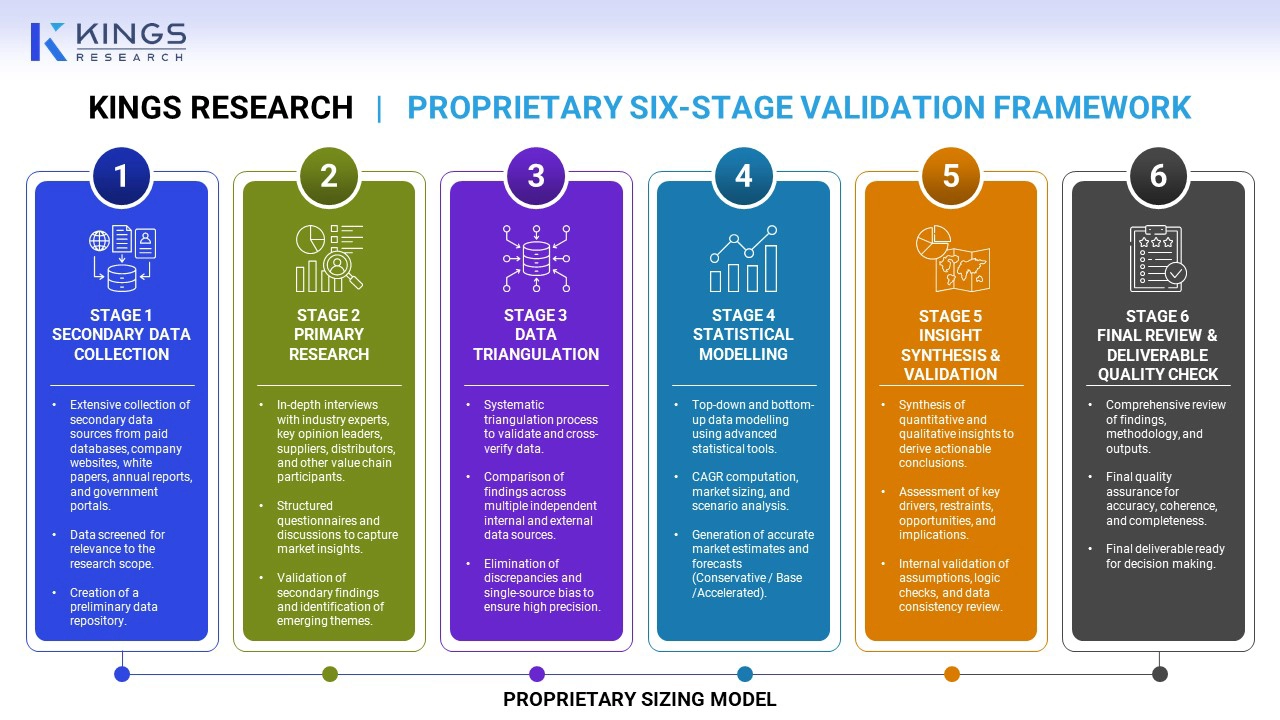
Our methodology triangulates insights from multiple independent and publicly available research databases and is further validated against regulatory filings and public company disclosures. All estimates are cross-verified; no single-source data is presented without validation.
Why Kings Research?
Our custom offerings deliver tailored, data-driven intelligence and strategic guidance to help organizations identify, evaluate, and capitalize on key market opportunities.