AI success isn’t measured by how quickly you automate, but by how effectively you solve real business problems.
To build an artificial intelligence strategy that actually drives business value, organizations must stop rushing to implement top-down mandates and fundamentally evaluate their data infrastructure. True technological acceleration is not about chasing the illusion of multitasking efficiency; it is about anchoring your AI ecosystem in clean data, strong governance, and measurable effectiveness.
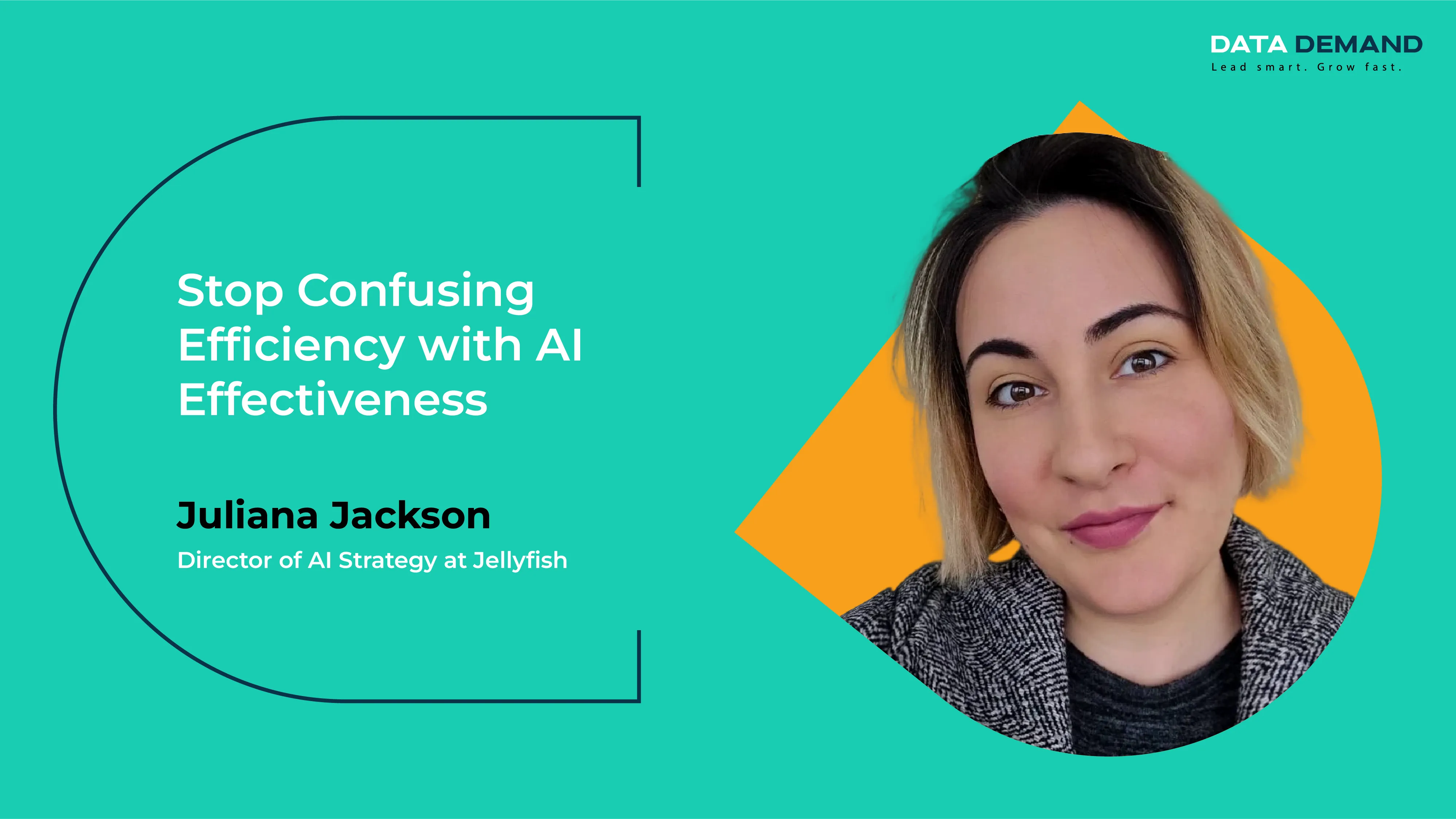
Based on the operational framework shared by Juliana Jackson on the MarTech360 podcast hosted by Samarth, here are the 5 core strategies required to transition your organization from chaotic AI experimentation to generating genuine commercial outcomes:
1. Stop Confusing Efficiency with Effectiveness
Many companies are stuck in a cycle of implementing AI simply to be first, confusing pure efficiency with bottom-line effectiveness. While artificial intelligence allows teams to multitask and execute tasks faster, it rarely transforms a business without a defined strategy. Leaders must start with a specific business problem and work backward, realizing that sometimes a process needs simple automation rather than expensive AI compute power.
2. Separate Traditional Machine Learning from Generative AI
Marketers often lump all automation together, but the industry has already been using machine learning for bidding, propensity modeling, and A/B testing for decades. The true disruption lies within Generative AI and Large Language Models, which are fundamentally changing the top of the funnel. Buyers have shifted from typing short keywords to having 30-minute conversations with models, forcing brands to optimize for conversational visibility and brand perception rather than traditional search.
3. Upgrade Legacy Data Warehouses for Agentic AI
Top-down AI mandates often fail because corporate data warehouses were built strictly for reporting, not for independent reasoning systems. You cannot successfully layer an active AI agent on top of a legacy reporting database without causing massive friction. To function correctly, agents require a dedicated modeling layer, a transformation layer, and a semantic layer that feeds them live, contextual business processes.
4. Keep LLMs Away from Raw Personal Data
Large Language Models are text predictors, not mathematicians. Connecting an AI system directly to personal identifiable information (PII) within a CRM is highly dangerous and creates severe compliance risks under regulations like the EU AI Act. Organizations should use traditional machine learning to handle data anonymization and numerical modeling first, and only feed the sanitized, structured results to a generative agent.
5. Enforce Strict Output Evaluation and Governance
There is a massive difference between an AI model successfully generating an output and that output actually being factually correct. Companies that skip the evaluation phase risk severe brand damage, such as chatbots making up fake refund policies or insulting customers. Organizations must work closely with data science teams to implement statistical evaluation techniques, like precision and recall scoring, to ensure human-in-the-loop governance.
Sustainable digital growth is not about forcing generative AI into every department simultaneously. It requires starting with agile departments like creative production or conversion rate optimization, upgrading your data infrastructure, and maintaining critical human oversight. Stop rushing to implement AI for the sake of headlines, and start building the strategic data layers required for actual business effectiveness.
How much of your current AI strategy is driven by a clear business use case versus a blind top-down mandate?