Marketing’s future is not about adding more tools. It is about building the infrastructure that allows AI, data, and human insight to work together.
To build a marketing engine that survives the age of AI, B2B leaders must stop hoarding point solutions and fundamentally rethink their data infrastructure. True digital acceleration is not about adding to a stack of 15,000 available MarTech tools; it is about building a cohesive system where AI agents can access a universal data layer.
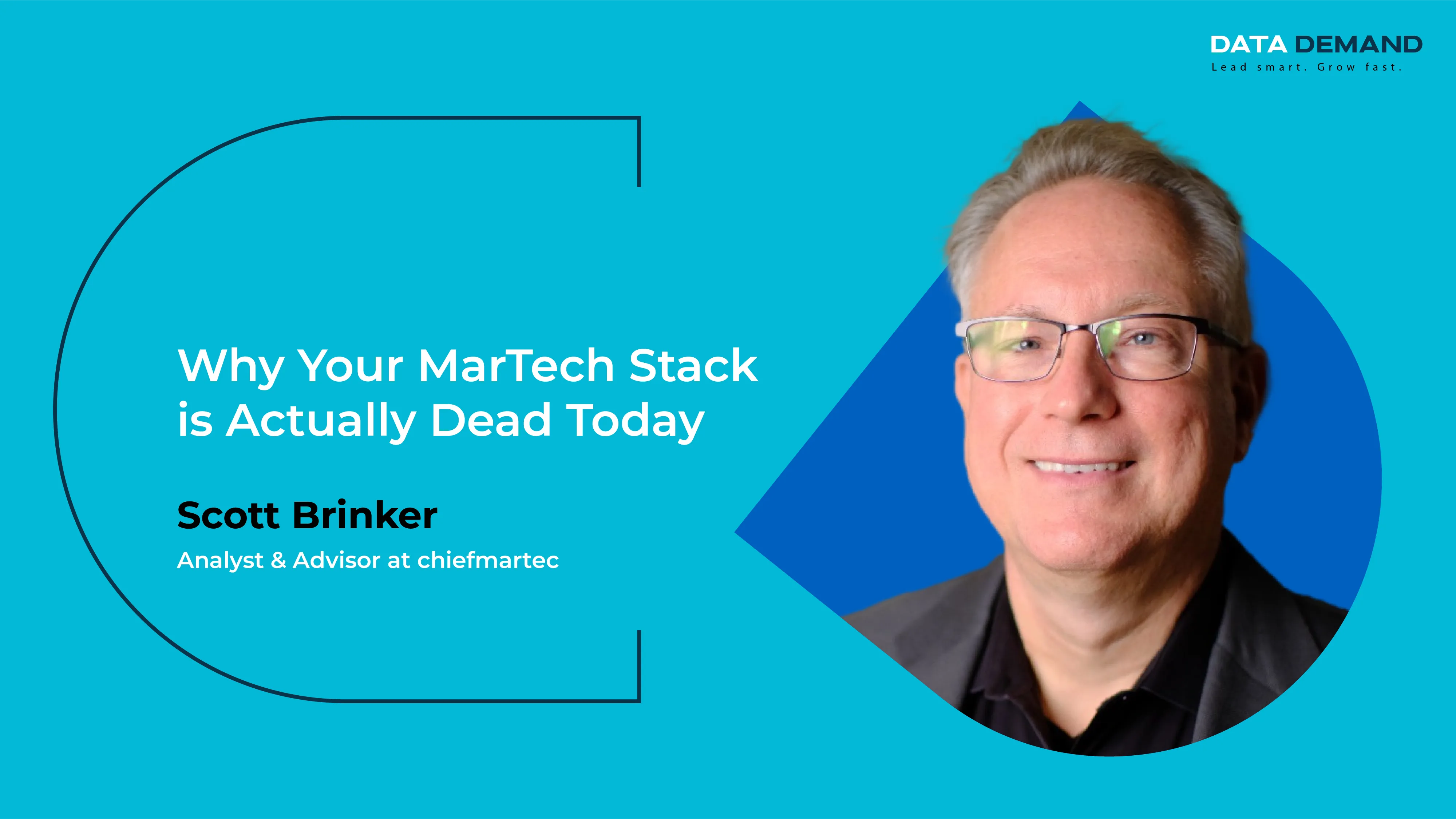
Based on the operational framework shared by Scott Brinker on the MarTech 360 Conversation podcast hosted by Samarth, here are the 5 core strategies required to transition your organization from a chaotic app collection to a modern, infrastructure driven marketing system:
1. Accept That Buyers Are Bypassing Your Funnel with AI
Scaling digital revenue fails when teams assume they still control the digital journey. Today, buyers are using their own AI models to research, evaluate, and make decisions without ever landing on your website or reading your content. Marketers must realize that traditional demand generation funnels are being disrupted, and they must adapt to serve both the human buyers and the AI assistants acting on their behalf.
2. Shift from Buying Apps to Building on Data Infrastructure
The idea of a single vendor suite that does everything is a complete myth. The MarTech landscape is splitting into two distinct categories, which are robust data infrastructure like Snowflake or Databricks, and the custom AI agents built on top of them. Instead of operating in disconnected application silos, companies must invest in a universal data layer and open APIs to give their AI tools the freedom to execute cross platform workflows.
3. Master ‘Context Engineering’ Over Prompt Engineering
Giving an AI agent access to terabytes of raw company data is a recipe for hallucinations and failure. AI models have limited context windows, meaning they can only hold a certain amount of working memory at one time. The critical new skill for modern marketers is context engineering, which involves selecting and packaging the exact subset of data an AI agent needs to perform a specific task accurately.
4. Let AI Run the Micro Tests While You Architect the Strategy
Early adopters are using AI reinforcement learning to automate the manual bottleneck of campaign testing. Instead of humans guessing and split testing a few variations for a churn prevention campaign, AI agents can systematically test thousands of combinations of offers, timing, and channels. This frees human marketers to step up and architect higher level strategies that focus on brand compliance and lifetime customer value.
5. Leave the Dashboard and Actually Talk to Your Customers
As buyers increasingly rely on AI to synthesize information, marketers can no longer rely solely on analytics dashboards to understand human behavior. The core purpose of marketing has never changed because you must go out into the real world and talk directly with your customers to understand their true motivations and challenges. Technology changes rapidly, but deep human understanding remains the unshakable foundation of business growth.
The Bottom Line: Sustainable digital growth is not about finding the perfect application suite; it is about treating MarTech as scalable infrastructure. Stop designing your organization for a rigid plan, and start designing your organization for continuous change.
How much of your current go to market strategy relies on a traditional website funnel that buyers are already abandoning?